My mother has been an emergency room nurse in Queens for more than 40 years. She has won awards, and she's served countless thousands of New Yorkers. My mother is also Italian, and if you know anything about Italian mothers, you know they are never at a loss for words. Most of her stories about the ER are not fit for republication here. But what I learned from her is that care goes beyond examinations, administering medications and performing procedures. Care is also about making a patient who is scared, worried or agitated feel calm and welcome.
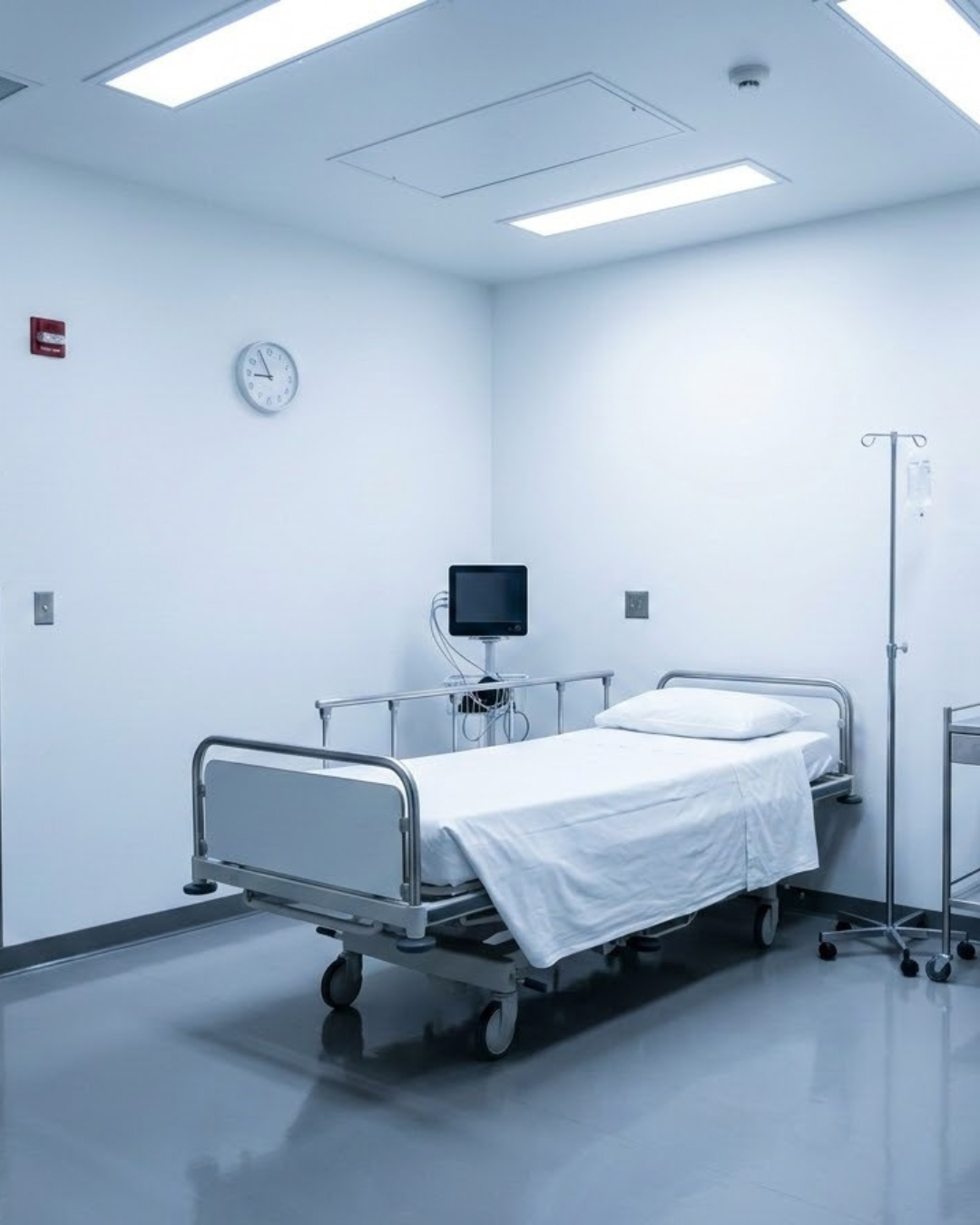
Stark hospital room
I have worked with light for more than 27 years, ever since I was a senior in high school, cranking hand dimmers to make the strip lights change color. Over that time, I've come to learn and love how light can affect every aspect of our everyday lives. Nowhere is that clearer than in healthcare. My mother's passion for her work spilled over to me, especially when I served as an industry advisor to the Light and Health Research Center at Mount Sinai.
While we often talk about light in the context of circadian wellness, it's frequently the more subtle effects of a lighting element that improve the psychological well-being of patients and their families.
Healthcare is as much about making someone feel seen and cared for as it is about making them medically "well." That presents a challenge for the designers of healthcare environments. Clinical spaces don't inspire a feeling of welcome. They are necessarily sterile, cold, and, to many, lifeless. But it doesn't have to be that way.
In interior spaces like patient rooms, procedure rooms and MRI suites, views of nature usually aren't possible. And in urban healthcare spaces in New York and Northern New Jersey, even when a view out is possible, you're often looking at streets, brick walls or the sides of buildings.
But it is possible to bring natural views into healthcare spaces, and with them some of the calm that nature provides.
Sky Factory is an Iowa-based manufacturer. The important thing to understand about Sky Factory is that it was founded by a visual artist whose passion for natural views is the company's founding principle. That's why the images Sky Factory creates are as much a part of the product as the lightbox itself. It is the closest you will get to an immersive natural view from an artificial source.
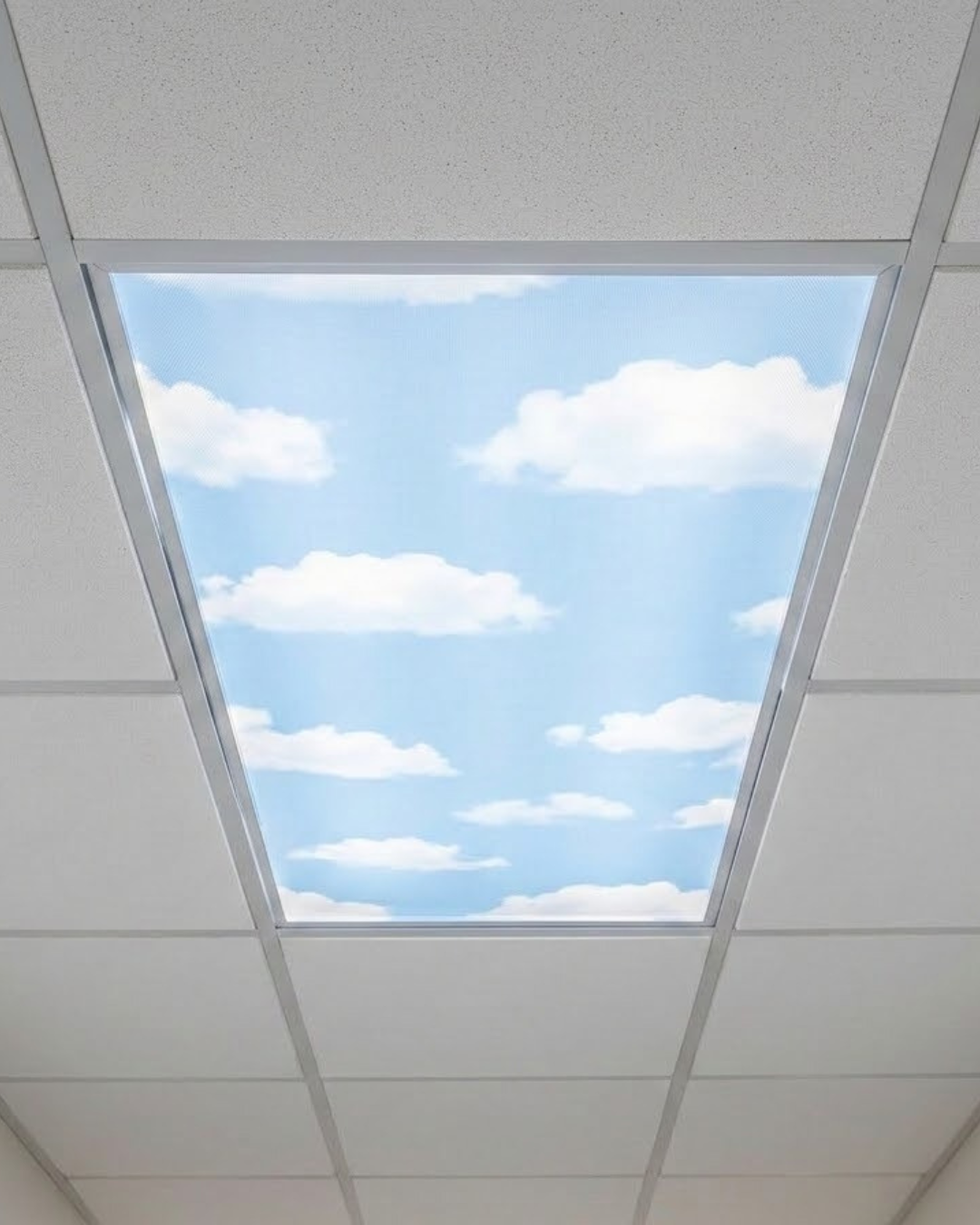
This is NOT SkyFactory
You're probably imagining the cheap faux skylights you've seen around (like the one above), where a printed overlay sits on top of a white lens. All I can tell you is that when we show a Sky Factory sample, even a small 2x2, people become immersed in the view. But why?
Sky Factory images are carefully composed to be deeply immersive. My favorite fact about how they're created is that each image is exposed at 100 different focal lengths. The exposures are then painstakingly layered together into a single composition where every part of the image is perfectly in focus. That might sound like a small thing, but it mimics how we see nature. When you look at a branch in the distance and then shift your attention to a flower two feet in front of you, your eyes refocus instantly. Most photography separates foreground from background, which can make a striking image, but not one with the complexity that captivates you and lets you get lost in it.
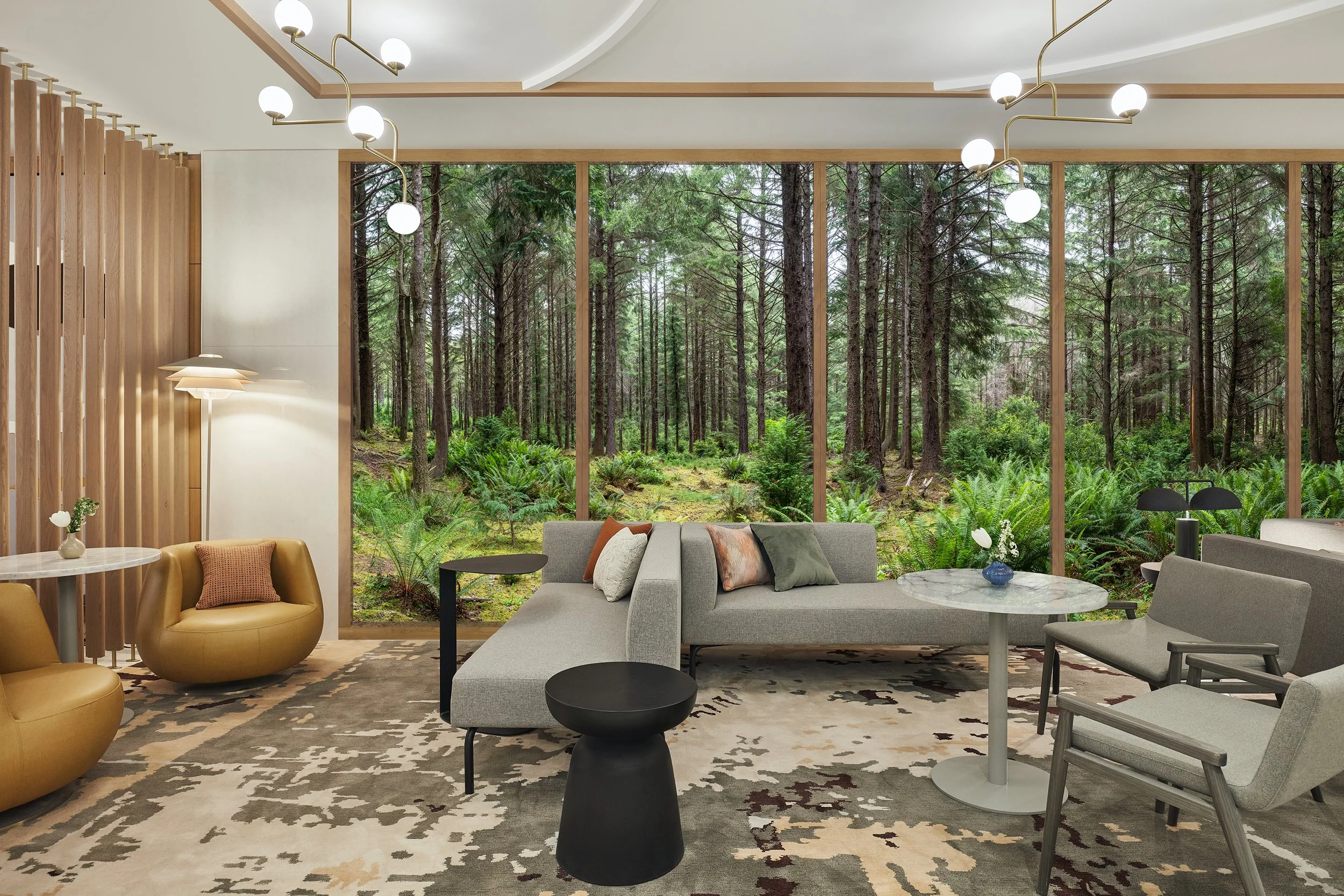
Each SkyFactory installation creates an diverse image you can get lost in.
But none of that artistry would matter if the product weren't also technically sound, so Sky Factory has developed light engines specific to each application.
Without diving into the entire portfolio, there are four product families to know (I'll cover their digital cinema products in another post):
Aperture SkyCeilings: circular and elliptical recessed skylight forms for organic, curved architecture.
Revelation SkyCeilings: architectural skylights with a mullion-like recess, in uninterrupted sizes up to 4' x 8'.
Classic SkyCeilings: originally designed for acoustical ceiling grids, for lightweight modular installation.
Virtual Windows: designed to install vertically within a standard stud wall, creating the look and feel of looking out a window.
All of them are backed by state-of-the-art LED light engines:
EcoPlus: a 6500K midday-like light engine developed for custom builds.
EcoSlim: a 6500K midday-like light engine for shallow plenums and low clearances.
IRIS: a tunable light engine designed to replicate the shift to sunset within the chosen image (the clouds turn pink before the sky does, for instance). IRIS can be pre-programmed or geolocated to match the sunrise and sunset times of your location.
EcoPlus and EcoSlim are both MRI compatible.
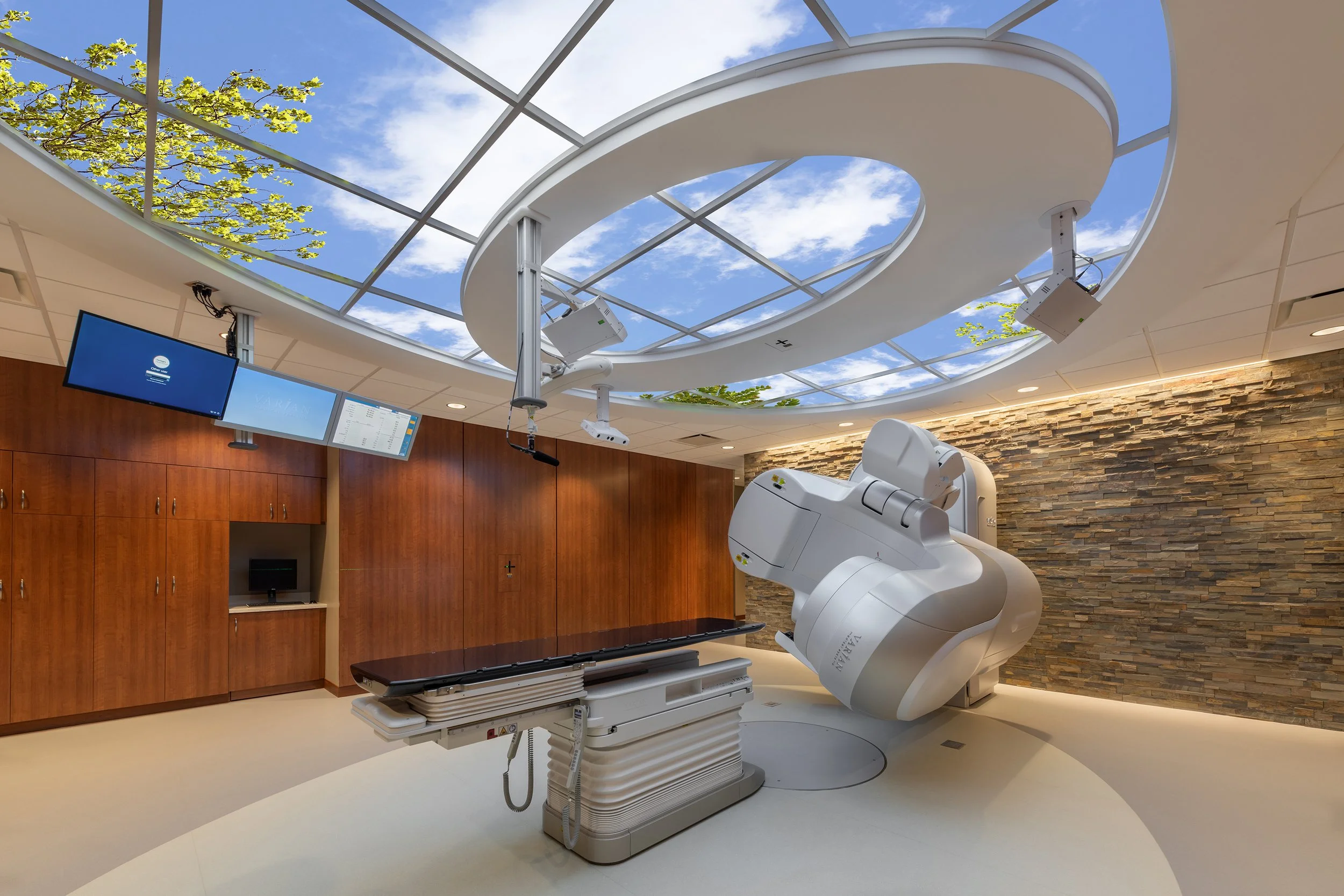
Science-backed
You might be thinking this all sounds like a very fancy light box with pretty pictures: beautiful to look at, but unlikely to affect patient outcomes in any appreciable way. I get that skepticism in a world where so many products make false claims. More than a decade ago, Sky Factory partnered with Texas Tech University to study patient outcomes.
Two studies followed. The first was "Neural Correlates of Nature Stimuli: An fMRI Study" (https://skyfactory.com/app/uploads/2023/08/fmri-Study-Press-Release.pdf), followed by "The Impact of Simulated Nature on Patient Outcomes: A Study of Photographic Sky Compositions" (https://pubmed.ncbi.nlm.nih.gov/26199272/).
The top-line finding from the fMRI study:
“The best expectation out of a relaxation-inducing positive distraction feature is diversion of one’s attention and consciousness from the immediate ailment and stressful environment. Neural activations in response to the visual stimulus used in this study suggest that cognitive diversions induced by photographic sky compositions may result in significantly different and higher levels of positive physiological responses as compared to positive images in general.”
The second study was even more direct. Published in the peer-reviewed Health Environments Research & Design Journal in October 2015, it followed 181 patients on a medical-surgical unit in a single-blind study. Patients in rooms with a Luminous SkyCeiling above the bed showed a 53% difference in acute stress and a 35% difference in anxiety compared with patients in identical rooms without one.
“Patients in rooms with a Luminous SkyCeiling above the bed showed a 53% difference in acute stress and a 35% difference in anxiety compared with patients in identical rooms without one.”
Sky Factory sits at the intersection of artistry, engineering, and emerging science. While I think it can enhance healthcare environments in many ways, it has limitations. Sky Factory panels are not designed to deliver functional light in any medical environment. Their brightness is tuned for direct view, meaning you can look straight at them comfortably. That light level isn't bright enough for safe ambient light, and certainly not for examination-level illumination. However, Sky Factory can be integrated into a complete architectural and medical lighting plan that delivers both performance and patient comfort.
Book a demo
Sky Factory is best experienced in person. Use the form below to book a demo at your office, where I'll bring a sample and we can talk about how Sky Factory can enhance your space.