Here's How to Prioritize Lighting on Your Next Project
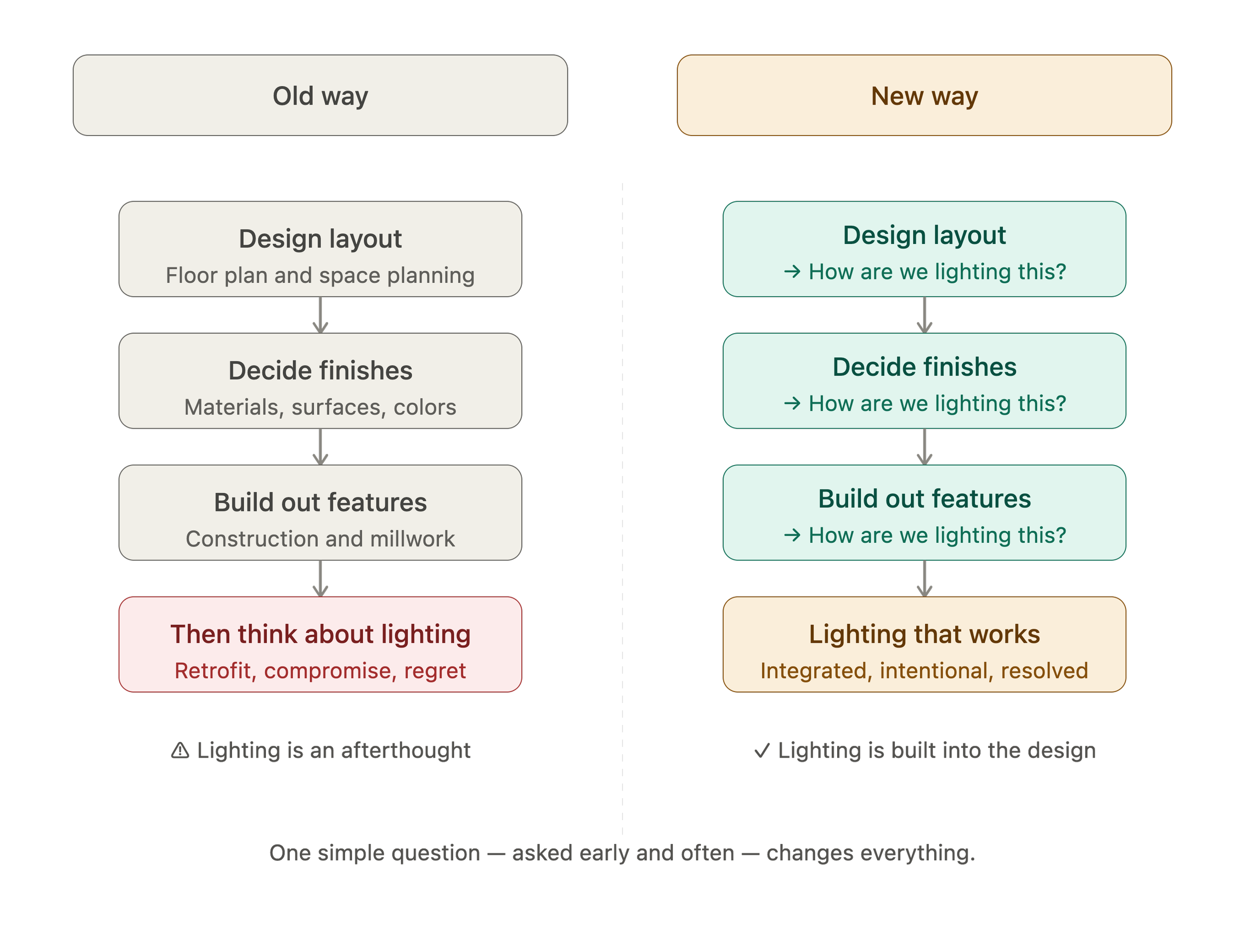
Too many times we've seen residential projects where the homeowner goes all in on important design features...the stonework, the millwork, the cabinetry, or tile. Then at the last minute, lighting comes into the conversation.
"Don't worry the electrician will put them in"
So the ambient light is a bunch of poorly placed, wafer-style downlights you never want to turn on because they are "too bright" (they are actually glare nightmares). Some undercabinet lighting that is the wrong color temperature and is leaving reflective streaks in your countertop, and un-lit art on the feature wall.
So how do we prevent this?
We Create a Virtuous Circle of Light
I ranted about this in a recent short video. But here's the habit loop we need to get into. Every time a design feature is decided, every time a room layout is settled on, the very next question should be "great, how are we going to light that?" It’s a simple shift in thinking that will radically change how lighting integrates into your design process.
But once you’ve made that shift, your project creates a virtuous circle where great light takes every feature to the next level.
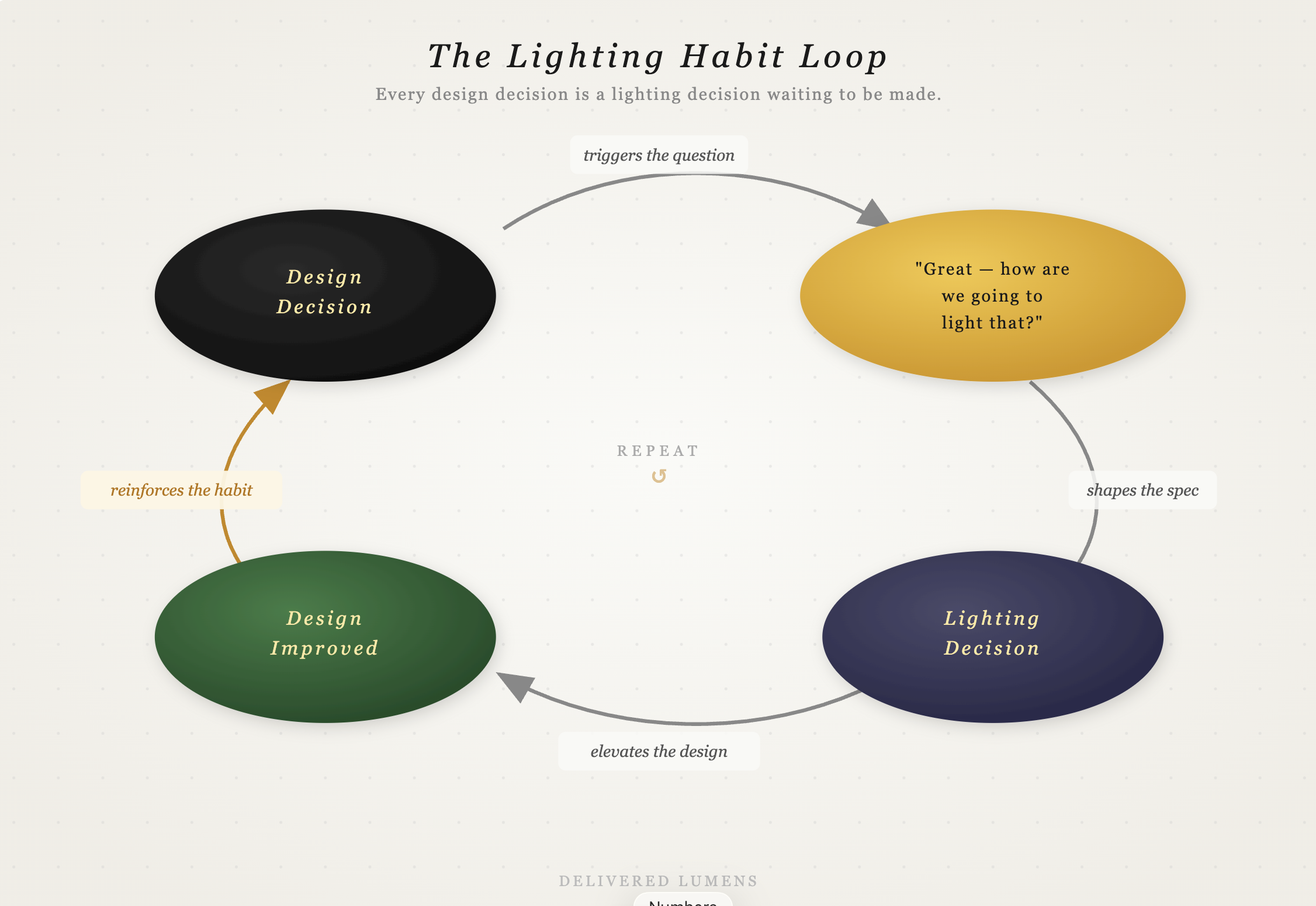
Creating that habit loop will accomplish four things:
Ensures lighting is thought about concurrently with the design.
Makes lighting an equal priority in the design process
Allocates room in the budget for lighting
Helps with the plan and prep of lighting within the larger design.
Let's take each of these individually.
Ensures Lighting is Thought about Concurrently with the Design
Too often in the design process, the interior design is presented without consideration for how each element of the space will be illuminated. It’s not that every piece needs to be spotlighted (that would be weird). It’s that each visual moment of the design may or may not need lighting, and if it does, it’s best to think about how that’s going to happen then and there. Which brings me to my next point.
Makes Lighting an Equal Priority in the Design Process
Let's take the example of a kitchen renovation. Depending on the countertop material chosen, you might have something honed that is a soft reflective surface, or you could have something polished, which is sharper when it comes to reflections. Neither decision is wrong, but how you light each decision will make a big difference in how the countertops are presented.
If the countertop is polished and reflective, the lighting needs to be positioned differently so you’re not seeing strips of light reflected back into your eyes. But that new placement might affect the way the cabinets are designed and built. It’s much better to learn that in the early design phase than when it becomes a change order later in the project, costing extra time and eating into budgets. Speaking of budget…
Allocates Room in the Budget for Lighting
If this kitchen in question is a real working kitchen (not just a showpiece), then the ambient light in the space is critical. Contractor-chosen wafer downlights are an unmitigated disaster, mostly because they're a glare nightmare. Poorly designed recessed lighting is why people say overhead lighting is “too bright.” What they mean is that they cast too much glare in the room.
The reality is that better shielded recessed lighting is more expensive. This is a worthy investment, especially in spaces where the lights will be on a lot. But budgets are real, and if the fixtures aren’t chosen early and money isn’t allocated, you might get stuck with whatever your contractor can get at Home Depot. This leads to the final point.
Helps the Plan and Prep of Lighting within the Larger Design.
Some lighting decisions have a way of rippling out through your larger project. It might be the style of recessed lighting you’ve chosen or the color temperature you prefer. If you’re designing multiple spaces, then some key decisions will carry over into the other spaces you're working on. After all, you'll most likely want your styles to at least be in conversation from room to room. This brings consistency to the lighting design throughout the home. If you’re lighting the dining room table with small adjustable accent lights and then it would make sense for a similar design language to carry through to the living room photo wall, for instance.
Make Light Part of Every Design Decision
If you need help with these lighting discussions, we're available.